


TVPI, Total Value of Paid-In Capital, measures the total value of a venture fund compared to the total capital LPs have contributed. It includes:
Realized Returns
The money already returned to LPs from exits (cash distributions), and;
Unrealized Returns
The estimated value of the fund’s remaining investments (startups that haven’t exited yet).
Let’s say LPs (Limited Partners) invested $10M in a venture capital fund. This is the total paid-in capital. Over time (probably five or more years), the fund has:
Distributions to LPs
This is money the fund has already returned to investors through startup exits.
In this example let’s say $15M has been distributed, meaning LPs have received 1.5x their original investment in cash.
Net Asset Value (NAV)
This is the estimated value of the fund’s remaining investments — startups that haven’t exited yet. Here, let’s say the NAV is $10M, meaning the fund still holds $10M in value that hasn’t been realized yet.
Here’s the TVPI formula:
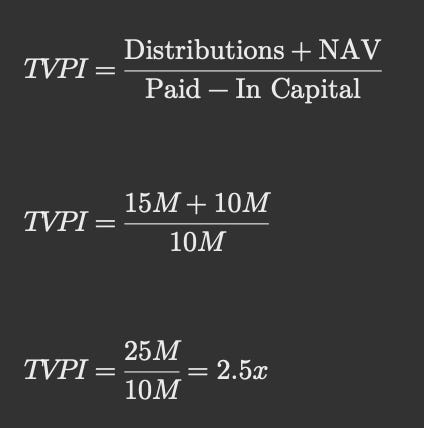
A TVPI of 2.5x means that for every $1 the LP originally invested, they now have $2.50 worth of value. Some of this is in paid-out cash and some in still-held investments.
The average TVPI for VC funds varies based on factors like vintage year (the year the fund was established), fund size, and market conditions. For instance,
25% of smaller funds (<$350 million) achieve a TVPI of 2.5x or greater.
17% of larger funds (>$750 million): achieve a TVPI of 2.5x or greater.
Resources to learn about TVPI:
https://carta.com/learn/private-funds/management/fund-
performance/tvpi/https://www.investopedia.com/terms/p/paidincapital.asp
https://www.angellist.com/learn/tvpi